Background:
Ideas: For precipitation modeling, the oldest object based method is the continous rain areas (CRA) method (Ebert and McBride, 2000). It decomposes the mean squared error (MSE) into a displacement, a volume and a pattern error while the pattern error is the residual of the other two. The method is based on the total MSE over the verification domain, that is the area average of the MSE values at each grid point. The questions is if CRA could be adapted for probabilistic forecasts by replacing the MSE with a probabilistic score, for example the CRPS or the Brier score. (A drawback of CRA in the downscaling context is the requirement of matching individual precipitation objects)
Hypothesis:
Topology in the rainfall field may have information about the topograph pattern that collectively influence the rainfall pattern. We want to explore the use of topological descriptors, such as Morse Complex that have recently found interesting applications to determine the connectivity of the graph nodes applied to Atmospheric River.
Refined hypothesis:
Notably, the AINWP is possible only because ERA5 data- a reanalysis product that assimilates observations into a numerical weather prediction model- is available. However, ERA5 is a global dataset and is not perfect because of the approximate nature of the reanalysis. Recently, Christensen et al. (2026) identify a recurrent, spatially coherent error in 2m temperature in ERA5 when comparing short-lead-time (6 h) forecasts from the MLWP model GraphCast against ERA5. We find that the same error feature is present in other MLWP models trained on ERA5, which arise from OI, when surface reports that are temporally displaced compared with the background forecast are assimilated. The spread from the ensemble of data assimilation partially flags these cases but is underdispersive. We assess the impact on a MLWP system trained on ERA5. While the MLWP model can largely ignore these unphysical error events, a small systematic degradation in forecast skill over the region is observed. We discuss the implications for using reanalysis as truth in machine-learning training and verification, and recommend simple changes to reduce such artefacts in future analyses.
ERA5 data: A quick overview (from Christensen et al. 2026)
ERA5 is based on the data assimilation system of the ECMWF Integrated Forecasting System (IFS) Cy41r2, which became operational on March 8, 2016. The reanalysis is produced using a four-dimensional variational (4D-Var) data assimilation process, which blends observations taken over a period of 12 hours with short-range (background) forecasts from the previous analysis update. In 1979, these observations numbered approximately 0.75 million per day, increasing to around 24 million a day by 2019 (Hersbach et al., 2020). ERA5 is produced at a horizontal resolution of 31 km, with 12-hour cycling from 9 pm to 9 am and vice versa, with hourly output saved. In addition to the main reanalysis, uncertainty information is generated by producing a lower resolution 10-member ensemble of 4D-Var reanalyses. This ensemble provides background-error covariance estimates for the high-resolution 4D-Var computation.
demonstrated the utility of topological descriptors in identifying errors in atmospheric reanalysis. We want to explore the use of topological descriptors, such as Morse Complex to identify the errors in the rainfall field both in space and time. We want to explore the use of topological descriptors, such as Morse Complex that have recently found interesting applications to determine the connectivity of the graph nodes applied to Atmospheric River.
Refer to paper: Error in ERA5 2m temperature identified using GraphCast
New paper accepted in QJ: Error in ERA5 2m temperature identified using GraphCast
What? Approx 7% of 6am UTC samples have a substantial error in near surface temperature over Ethiopia.
Why? Temporal error in the reanalysis due to sparse observations taken later than the standard synoptic time of 6am, combined with thresholding behaviour due to quality control checks in DA procedure.
What about ML weather prediction models trained on ERA5? Well, GraphCast largely learns to ignore the error (which is how we identified it in the first place) - but it does show systematic biases consistent with hedging against it.
What next for ML weather prediction models? We propose that during training they should use the uncertainty estimates provided with ERA5, as these indicate the quality of the reanalysis on a case-by-case basis.
A substantial error in near surface temperature - Why? Temporal error in the reanalysis due to sparse observations taken later than the standard synoptic time of 6am, combined with thresholding behaviour due to quality control checks in DA procedure.
What about ML weather prediction models trained on ERA5? Well, GraphCast largely learns to ignore the error (which is how we identified it in the first place) - but it does show systematic biases consistent with hedging against it.
What next for ML weather prediction models? We propose that during training they should use the uncertainty estimates provided with ERA5, as these indicate the quality of the reanalysis on a case-by-case basis.
Why topological descriptors? When the error has a structural component, the pixel level analysis is not sufficient to capture the uncertainty in the system. We want to explore the use of topological descriptors, such as Morse Complex.
India
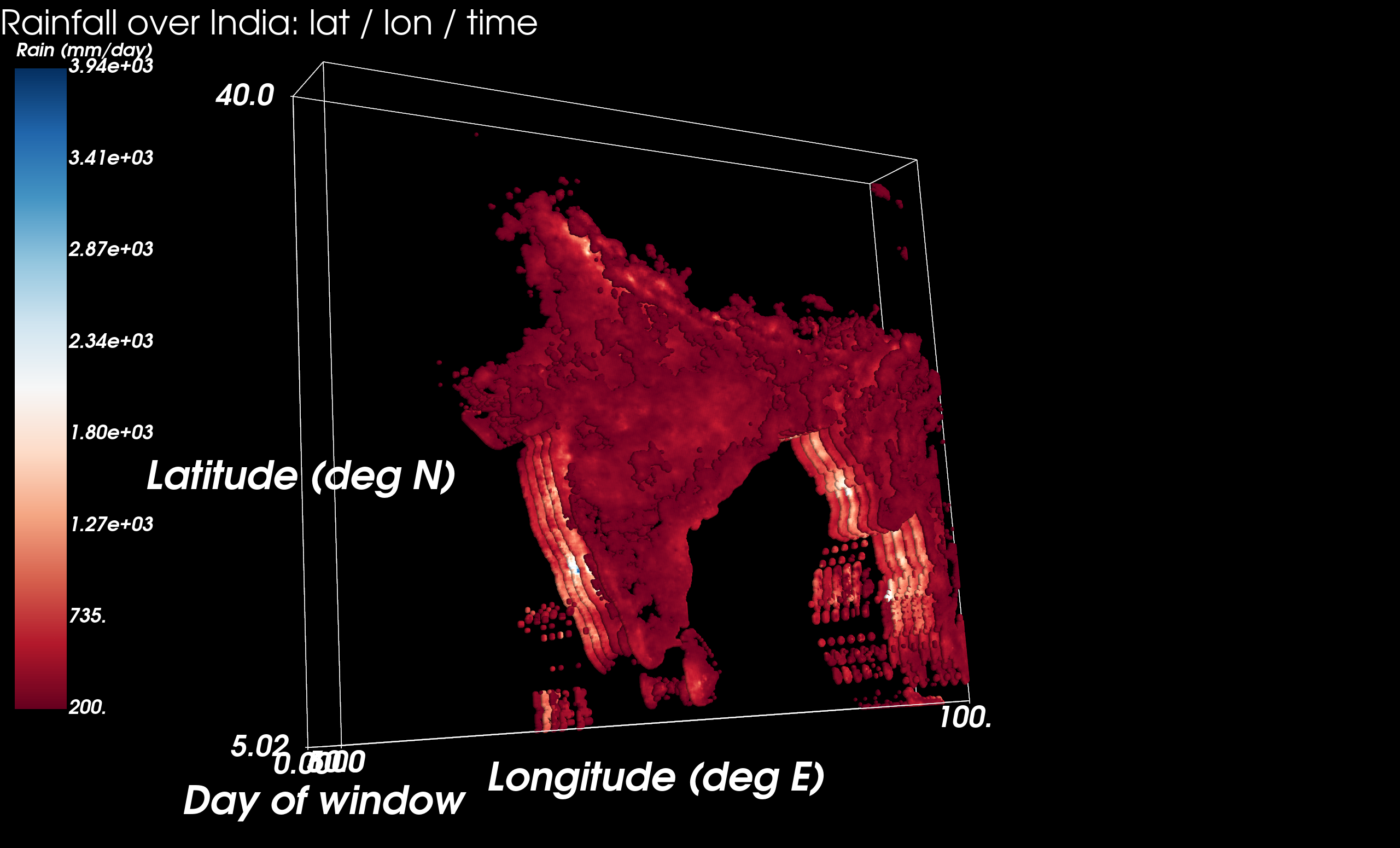
Preprocesssing Steps:
Can we seperate the signatures - distinguish between multiple datasets of the same region? Can we seperate the signatures - distinguish between multiple datasets of the same region? Can we use topological descriptors to identify the differences in the rainfall patterns across different datasets? Can we use topological descriptors to identify the changes in the rainfall patterns over time?
Datasets:
CHIRPS
IMERG
ERA5
References:
Christensen, H.M., Barker, J., Antonio, B., Bonavita, M., Dahoui, M. & de Rosnay, P. (2026) Error in ERA5 2-m temperature identified using GraphCast. Quarterly Journal of the Royal Meteorological Society, e70309. Available from: https://doi.org/10.1002/qj.70309